Margaritaville at Sea Paradise Best Cabins and Suites: What to Book
For most Margaritaville at Sea Paradise couples, compare Oceanviews 6065 and 6066 first for daylight and a cabin deck above and below.
Choose an Interior to protect the budget, a Junior Suite for indoor space, or a Grand Terrace Suite when its private balcony will be part of your vacation every day.
Short version
Start with Deck 6 Oceanviews 6065 or 6066 for two or three guests, or Interiors 6031 or 6032 when four beds matter more than daylight. Junior Suites 5331 and 5332 add indoor space beside the Deck 5 lobby; Grand Terrace Suites 1001 through 1010 supply the only private balconies beneath Deck 11 activity.
The four current cabin choices
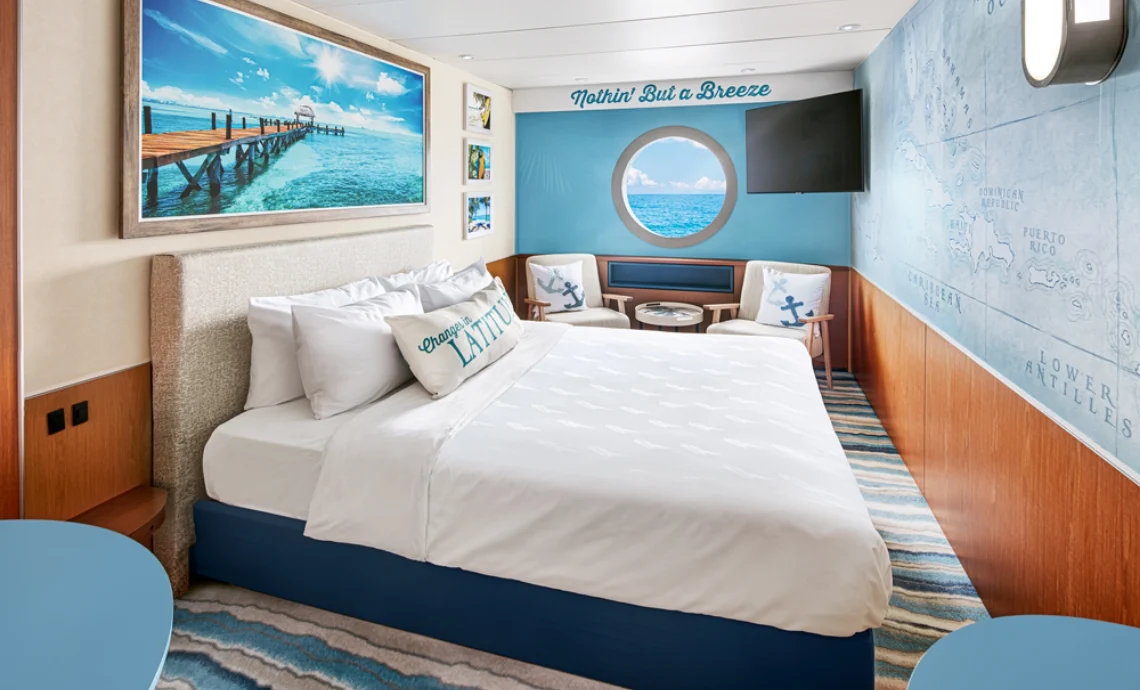
Cozy Interior Staterooms
Start a budget family comparison with Interiors 6031 and 6032 on Deck 6: the plan marks two convertible single beds and two upper berths in each. They have cabins above and below, but those upper beds still need to suit the people using them.
Their strongest advantage is price: on a short three-night or four-night itinerary, travelers who expect to spend most waking hours in port or in public areas may get little value from paying for a view. A dark room can also be helpful for sleeping after a late night.
The compromise is not merely the missing window. Four people in an interior room will have limited open floor area and storage access when beds are in use.
Families should coordinate morning routines and keep the room organized. Couples who are light sleepers may appreciate the darkness, but anyone prone to feeling enclosed should move up to an ocean view.
Location within the deck still matters, especially on Deck 7 below the entertainment and dining band.
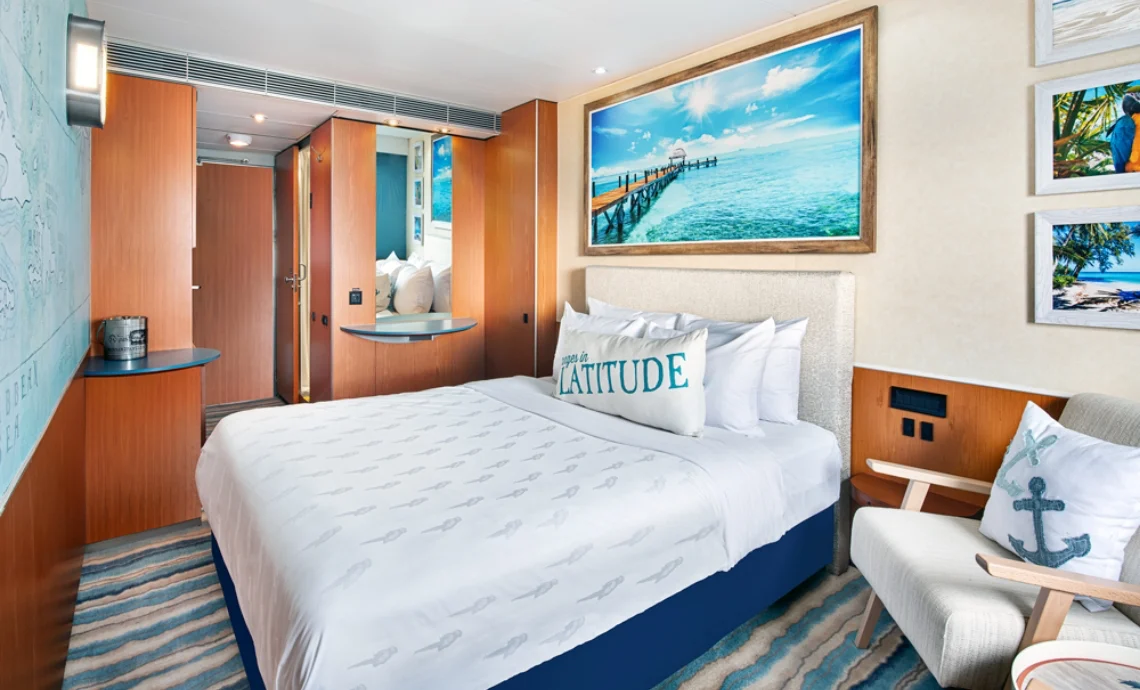
Picturesque Oceanview Staterooms
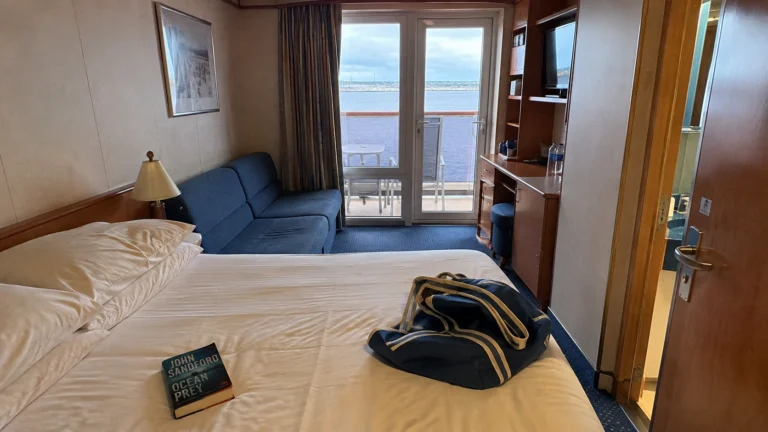
Oceanviews 6065 and 6066 are useful ordinary-room candidates on Deck 6, a few cabins from the forward elevator lobby. The plan marks two convertible singles and one upper berth, so compare them for two adults or a party of three, not four.
Their window provides natural light and an easy visual check of weather and arrival, which can make an older, compact ship feel more open. For most couples, this is the strongest all-around value category on Paradise.
The window does not open, and an ocean view does not provide outdoor space. Some rooms near the bow may have a more angled outlook or feel more motion, while rooms low and midship generally feel steadier.
Check the window description for the particular Oceanview before booking if the outlook is important. Compare the Paradise deck plan and our Paradise cabin cautions for location tradeoffs before assuming a category photograph establishes your room’s outlook.
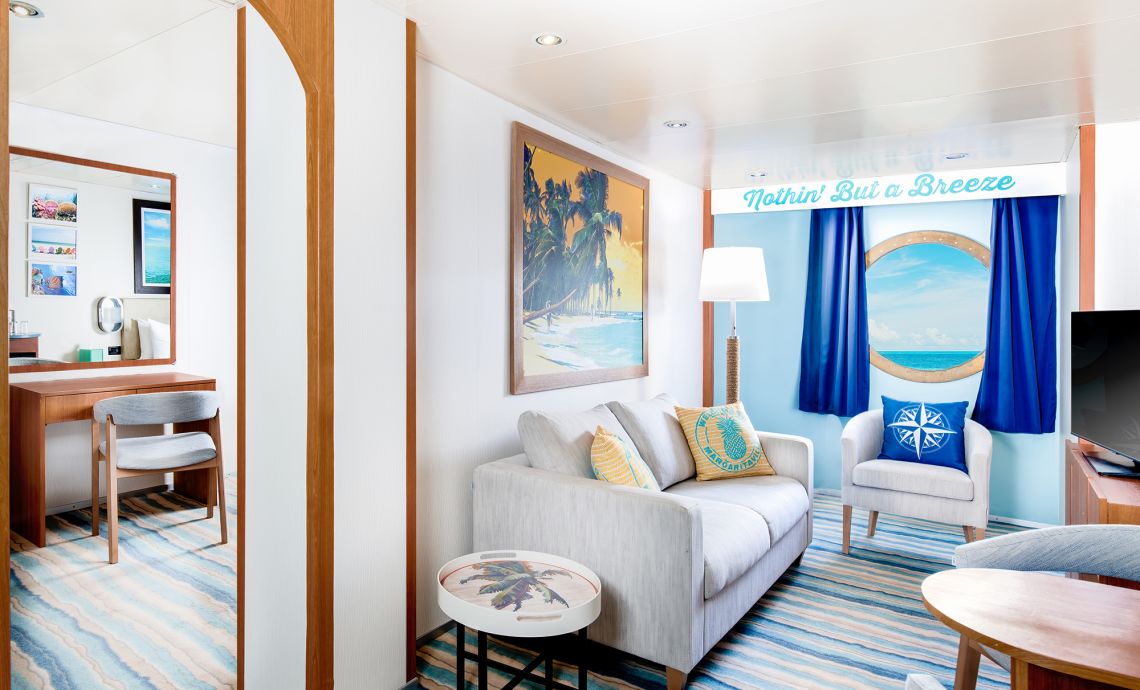
Serene Junior Suites
The Junior Suite description lists approximately 407 square feet, two large portholes, a pull-out sofa, two TVs, desk areas, and extra closets. Confirm the complete bed setup for your party before choosing an up-to-four room.
A Junior Suite is useful when extra indoor room and storage matter more than a balcony. Suites 5331 and 5332 flank the Deck 5 central lobby, so weigh that convenient public location against your preference for separation from passing guests.
The key limitation is clear: Junior Suites do not have balconies. Their value therefore comes from extra interior room, not private outdoor space.
On a short sailing, a couple may prefer to spend the difference on specialty dining, drinks, or a shore day. A family of four may find the added room far more valuable.
Compare the full package, cancellation terms, and included perks because the word “suite” does not by itself establish every benefit.
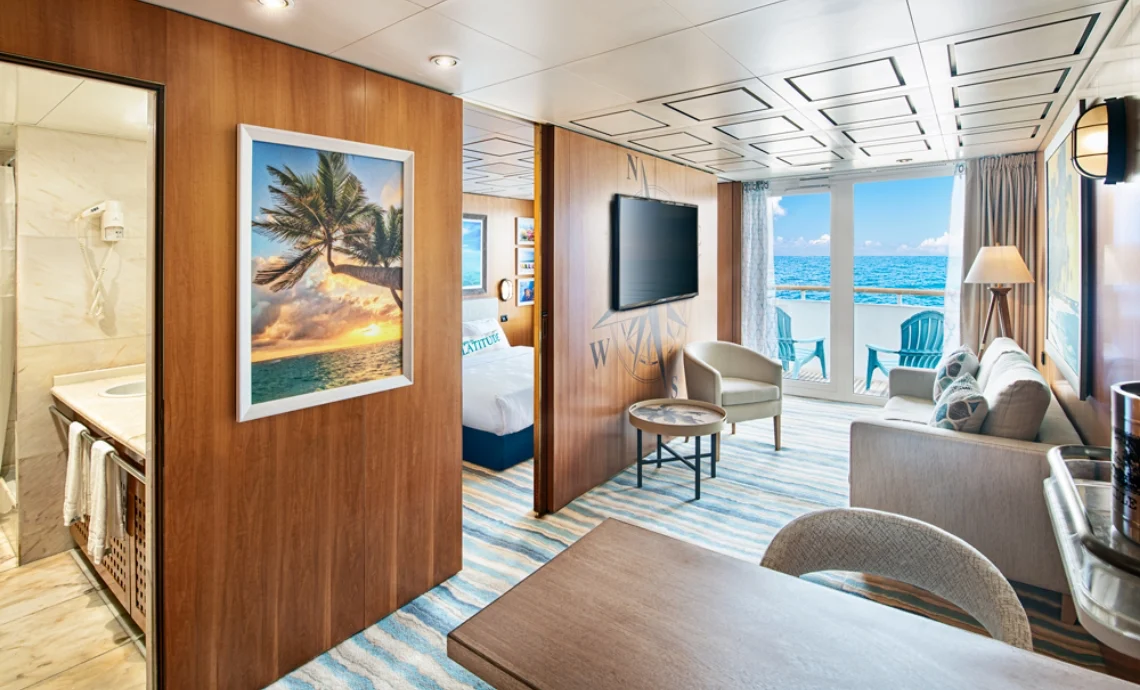
Luxurious Grand Terrace Suites
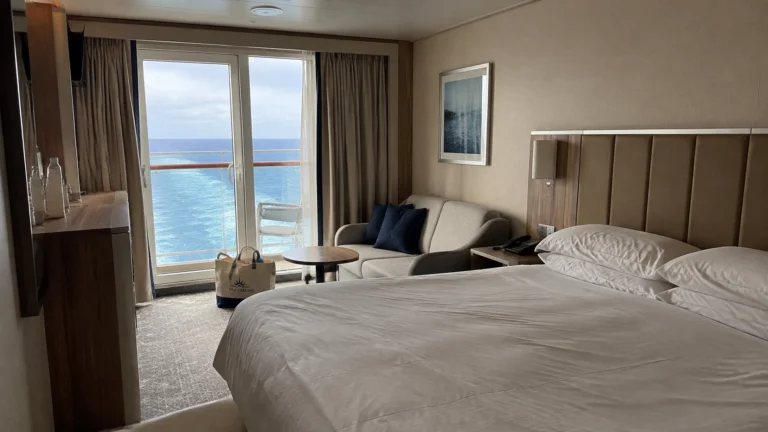
The ten Grand Terrace Suites occupy a midship block on Deck 10 and sleep up to four. They are the only current accommodations with private balconies, so reserve this category if stepping outside from your room is essential.
The official listing also identifies a queen bed, pull-out sofa, shower, and large jetted tub. This is the clear top choice for travelers who will use a balcony for coffee, sailaway, or private fresh air.
The tradeoff is location. Deck 10 is part of the upper activity zone rather than the quiet cabin stack.
The main pool and entertainment area are above on Deck 11, while casual dining occupies the aft part of Deck 10. Compare the actual suite ceiling if pool music or moving furniture would affect your rest; the location supports a caution rather than a guarantee of noise.
The balcony is scarce enough to command a premium, so judge it by likely use rather than by status.
Choose by your main priority
- Best for most couples: compare Oceanviews 6065 or 6066 on Deck 6, balancing light, access, and price.
- Best low-price choice: compare Interiors 6031 or 6032 on Deck 6, especially for travelers who treat the room mainly as a place to sleep.
- Best for four without the top suite price: a Junior Suite, after confirming the pull-out arrangement and total suite benefits.
- Best for private outdoor space: Grand Terrace Suite on Deck 10, since no other current category includes a balcony.
- Best for motion sensitivity: a lower, central room on Deck 4 or 5, away from the extreme bow and stern.
- Best for quick access to nightlife: Deck 7, with the understanding that proximity can bring sound from venues above.
- Best for guests who use elevators often: a room near, but not directly beside, a central elevator lobby. This shortens routes without putting the door at the busiest intersection.
How each cabin deck changes the experience
Deck 4: Coral Reef
Coral Reef is the lowest passenger cabin deck shown on the current plan. Its low position can be reassuring for travelers sensitive to motion, and it separates sleepers from the principal nightlife decks.
The cost is vertical distance: most dining, pools, youth spaces, and entertainment require an elevator ride or several flights of stairs. Rooms at the far ends also create a longer horizontal walk.
Deck 5: Changes in Attitude
Changes in Attitude combines cabins with the ship’s lobby and service functions. It contains the Serene Junior Suites as well as interior and ocean-view rooms.
This is a convenient base for guests who value guest services and straightforward access to arrival-day questions. Rooms close to the lobby or elevator landings may hear more passing conversation, so choose several doors down if sleep is the priority.
Deck 6: Flip Flop
Flip Flop is a largely residential buffer within the central cabin stack. It is one of the easiest recommendations because it avoids being directly inside the public-space band while keeping Decks 8 and 9 within a manageable walk.
Midship rooms are particularly practical. Check connecting-room symbols if sound transfer worries you, and avoid assuming that “midship” means directly beside an elevator.
Deck 7: Riddles in the Sand
Riddles in the Sand is convenient but requires the most careful room-by-room check. Deck 8 above contains the lower level of Stars on the Water Theater, Euphoria Lounge, youth and meeting spaces, JWB Prime Steakhouse, and Fins Dining.
A room below a stage, lounge, galley, or heavily traveled public entrance can hear activity. Deck 7 can still work well for night owls who want a one-flight route home, but quiet-seekers should favor Deck 6.
Deck 10: 5 o’Clock Somewhere
The Grand Terrace block is high and midship, connected to the upper food and pool neighborhood. Choose it when private outdoor time outweighs a cabin-only setting, and inspect the Deck 11 footprint before paying.
Guests who retire early should study what is beside and above the chosen suite. Those who value the balcony may consider the location a fair exchange.
Noise, motion, and room-position decisions
Paradise is 723.6 feet long and carries up to 1,680 passengers on the current official plan. It is easier to cross than a modern mega-ship, yet room position still affects daily effort.
Central rooms shorten many daily routes, while forward rooms favor the theater and aft rooms favor Fins Dining. The Grand Terrace block is midship, so don’t choose a forward ordinary room expecting it to be beside those suites.
The bow and stern can feel more motion than the middle in rough water.
For noise, look one deck above and below, not just beside the room. Public rooms, food preparation areas, pool equipment, elevator foyers, and connecting doors can all change the experience.
A blank space on a consumer deck map is not proof of silence because it may contain crew or mechanical functions. If a particular quiet-room requirement is essential, ask the cruise line or booking agent to identify the adjacent space before final payment.
Accessible rooms and other specially configured accommodations should be booked according to actual need and current availability. The official plan marks certain accessible positions, but door width, bathroom layout, equipment storage, and assistance requirements deserve direct confirmation.
Use the accessible cruising guidance and Access Desk for doorway, bathroom, threshold, and device-storage details. An ordinary suite’s larger footprint doesn’t make it an adapted room.
Match the room with the routes you’ll repeat
Use our Paradise deck guide to picture the trips between your room, breakfast, and the evening show. A low central cabin is a sensible motion-focused choice, but meals and pools still require several decks of travel.
A guest comfortable with stairs may like Deck 6 for the two-flight route to Deck 8. If stairs are difficult, choose a location that makes your preferred elevator bank convenient and allow more time around show finishes and port departures.
Compare space with time aboard
Choose the Junior Suite when you expect someone to rest indoors while others get ready, or when four guests need storage and a sitting area. For two adults spending nearly every day ashore, that extra room may matter less than the view in an ordinary Oceanview.
Grand Terrace earns its price when you’ll use the balcony, sitting area, or larger bathroom deliberately. Put an unhurried cabin breakfast or an outdoor arrival into the plan if those features are the reason for upgrading.
Our Paradise spending tips help you price the extras after selecting the room. Leave money for the shore day and dinner you most want rather than letting the suite premium consume the entire vacation budget.
Before you commit to the upgrade
The onboard charge schedule lists $22 per person per night in ordinary rooms and $25 in suites, plus Paradise’s currently posted $15 nightly fuel supplement. Two people over four nights add $296 in an ordinary room or $320 in a suite before other purchases.
Keep the quote for your original room beside the upgrade price, with the same fare terms and guests included. Confirm the actual room number, beds, occupancy, and documented benefits so a category change doesn’t quietly trade a good location for a feature you won’t use.
If an offer leaves the room unassigned, decide whether you would accept every eligible location. A small saving isn’t useful when you need a central position or residential ceiling to enjoy the trip.
For most couples, the well-placed Oceanview remains the first comparison because it adds daylight without the scarce-balcony premium. Choose the larger category only when its specific features improve the way your group will spend these few nights.
How this guide was researched
Checked all four current room descriptions, occupancy and suite features, access requirements, fixed charges, and the live-linked layout visually. Noise and motion advice describes exposure; exact booking details control beds, views and included benefits.