Diamond Princess Cabins to Avoid (and Where I’d Book Instead)
Choose your Diamond Princess cabin by the spaces around it, the view you are buying, and how everyone will sleep once the extra beds are open.
The rooms below can still suit the right traveler, but check these particular compromises before accepting a cabin number or a guarantee fare.
Short version
For light sleepers, start with cabins nearer the middle of Baja or Caribe. Check Emerald evening venues, Aloha spaces overhead, individual balcony obstructions, and the exact linked family-suite beds before booking.
Start with cabins above and below your room
If you are a light sleeper, begin your search on Baja Deck 11 or the central cabin areas of Caribe Deck 10. Much of this accommodation has other cabins directly above and below, which reduces your exposure to pool furniture, restaurants, and late entertainment.
Baja B400 and B401 are useful specific balcony rooms to compare near the middle of the ship. They are BA-category rooms, while Caribe C402 and C403 are IA inside rooms if you would rather save money for the ports.
B400/B401 favor a central elevator routine and separation from the main public decks, while C402/C403 make the same broad location choice without a balcony. A laundry doorway or internal connecting door still deserves attention when comparing another room nearby.
Use the official deck plans for your sailing date, then compare the room with our best Diamond cabins. A sensible location reduces avoidable risks; it cannot promise that neighbors or the sea will be quiet.
Avoid buying an aft balcony without checking its obstruction notes
Be careful with Emerald E735 if an open wake view is the main reason you are paying for a balcony. It is a Premium Balcony room with an aft position, but its individual cabin notes flag a partial balcony obstruction from a support beam.
E735 may still be a good purchase if the fare reflects that compromise and you mainly want somewhere outside to sit. It is a weaker choice for someone expecting the unobstructed panorama suggested by an appealing category name.
Compare Caribe C748 or C753 instead if a wake-facing standard balcony is your priority. Their room details list the same 277-square-foot total size without the support-beam note, and both are two-person cabins.
That total includes the balcony, so do not read it as the indoor floor area or use it to assume an exact balcony depth. Ask for a photo of the room’s balcony if your decision depends on the space for particular furniture or an unobstructed camera angle.
Treat E730 and E733 as suites with a view compromise
Emerald E730 and E733 are aft Vista Suites, not ordinary balcony rooms, and their room notes also flag support-beam obstructions on the balcony. Paying a suite fare does not remove that physical limitation.
Skip them if your celebration depends on a clear view across the whole stern. Their 527-square-foot published total, shower and tub, and three-person capacity can still appeal if you value the accommodation and suite benefits more than a perfect balcony sightline.
Compare Caribe C752 or C757 for an aft Penthouse Suite alternative. Those S3 room details list 525 square feet including the balcony, accommodation for three, and a shower and tub without the support-beam note.
Check the fare and the individual layout rather than assuming a category higher on a price list always gives you more usable space. Our suite recommendations explain the difference between an aft view and a more central position.
Do not choose the largest suites only from the headline size
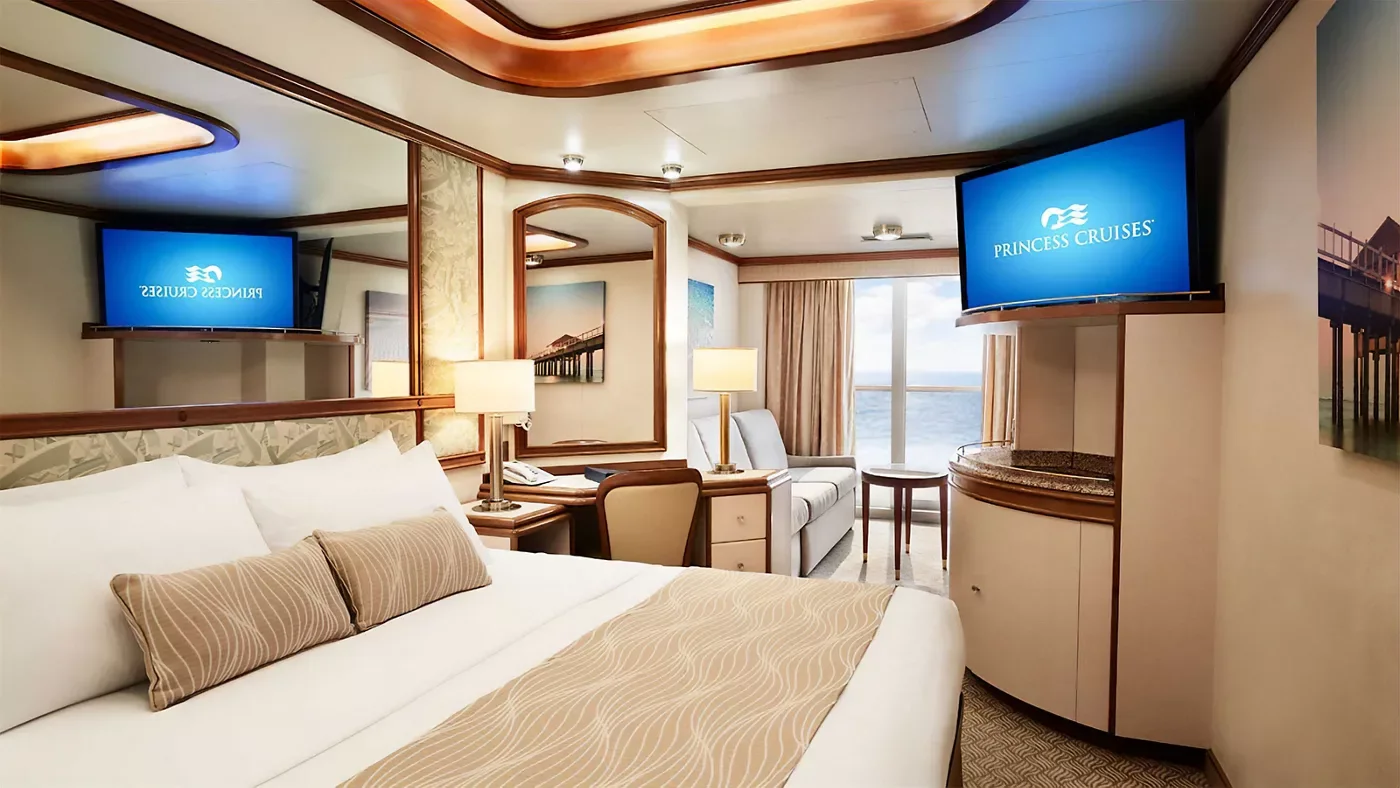
Baja B750, the Grand Suite, is a particularly important room to inspect before paying a substantial premium. Its room details list 1,329 square feet in total, room for four, a queen bed that stays a queen, and a balcony support-beam obstruction.
Avoid B750 if you need the main bed separated into twins or want an entirely open balcony view. The size may be excellent for your group, but neither the sleeping arrangement nor the obstruction changes because the suite is large.
B751, the Owner’s Suite across the stern, also carries a support-beam note and a four-person capacity, with a published total of 692 square feet. Ask for the sleeping arrangement and balcony view before comparing it with B750 on price alone.
For a couple who wants a full suite with shorter everyday walks, compare the midship S4 Penthouse Suites on Caribe, such as C400 or C401. Their published total is 555 square feet, and their more central position is useful when your days include the atrium, theater, and pools rather than mainly the aft venues.
Choose Emerald mini-suites carefully if you go to bed early
The aft Emerald mini-suites, including E710, E711, E712 and E715, sit above the aft public areas on Promenade Deck 7. Club Fusion and the adjacent evening venues make this an area to examine closely if music or later activity would bother you.
Avoid choosing one solely because the balcony looks sheltered or the fare looks attractive. The relevant question for an early sleeper is what will be happening beneath the room during the hours you want to sleep.
Compare a Dolphin mini-suite farther toward the middle of the ship, where Emerald accommodation lies underneath. D400 and D401 are Reserve Collection mini-suites if you also want the associated dining benefits, but ordinary mini-suite options can be cheaper when those benefits are not important.
Check balcony coverage and privacy separately before swapping decks. You might prefer Emerald’s particular balcony arrangement enough to accept its location, but that should be a deliberate decision rather than a surprise after boarding.

Aloha rooms beneath public areas need an individual check
Do not treat Aloha Deck 12 as automatically restful simply because most of it is accommodation. The ship skips numbered Deck 13, so Lido Deck 14 is directly above it, with pools, food counters, and Horizon Court across much of the deck.
An Aloha room can be convenient if you want a short route to swimming or breakfast, but it is a weaker first choice for someone sensitive to activity overhead. Trace the room position against Lido rather than ruling out every Aloha room equally.
The forward Lido cabins above some Aloha accommodation create different conditions from the central pools and aft buffet. Our Diamond deck guide helps you compare those areas without mistaking proximity for the same risk everywhere.
If the price difference is modest, move down to Baja and compare a room in a similar fore-and-aft position. You will give up some immediate pool access in exchange for having cabins overhead in much of that deck.
Forward and high cabins are a weaker choice for motion sensitivity
Skip the high forward Lido rooms, such as L200 and nearby accommodation, if ship movement has spoiled previous trips. Their location toward the bow and above most of the cabin decks is the reason for caution, even though the route to the pools is convenient.
Choose a room nearer the middle of the ship on a lower cabin deck instead. Caribe or Baja can be a better starting point than the extreme forward or aft ends when managing motion matters more than a particular view.
The forward Dolphin family suites deserve the same discussion when traveling with someone prone to seasickness. They provide a useful family arrangement, but their position at the forward end is a tradeoff that a larger room does not solve.
Consider the itinerary and your own experience before paying for an upgrade. The ship overview is useful for comparing room types, while your booked room number is what determines its position.
An obstructed oceanview is only a bargain if you accept the view
Emerald has obstructed oceanview accommodation alongside the lifeboats and their equipment. Forward E100 and E101 are specifically recorded as fully obstructed, so avoid them if watching the sea from your room is important.
These rooms can still suit a traveler who wants daylight at a lower price and spends most of the day elsewhere. Pay for that benefit knowingly rather than expecting a small obstruction you will barely notice.
Ask for the individual obstruction description or a current room photo before choosing another Emerald oceanview. A lifeboat, its davits, and a gap between boats create different views, and a general category photograph may not show your particular room.
If you mainly want a place to sleep, compare the price with an inside cabin instead. If the view matters, spend the upgrade on a verified unobstructed oceanview or balcony rather than hoping the cheapest obstructed option will provide one.
The family suites need both linked rooms and the right head count
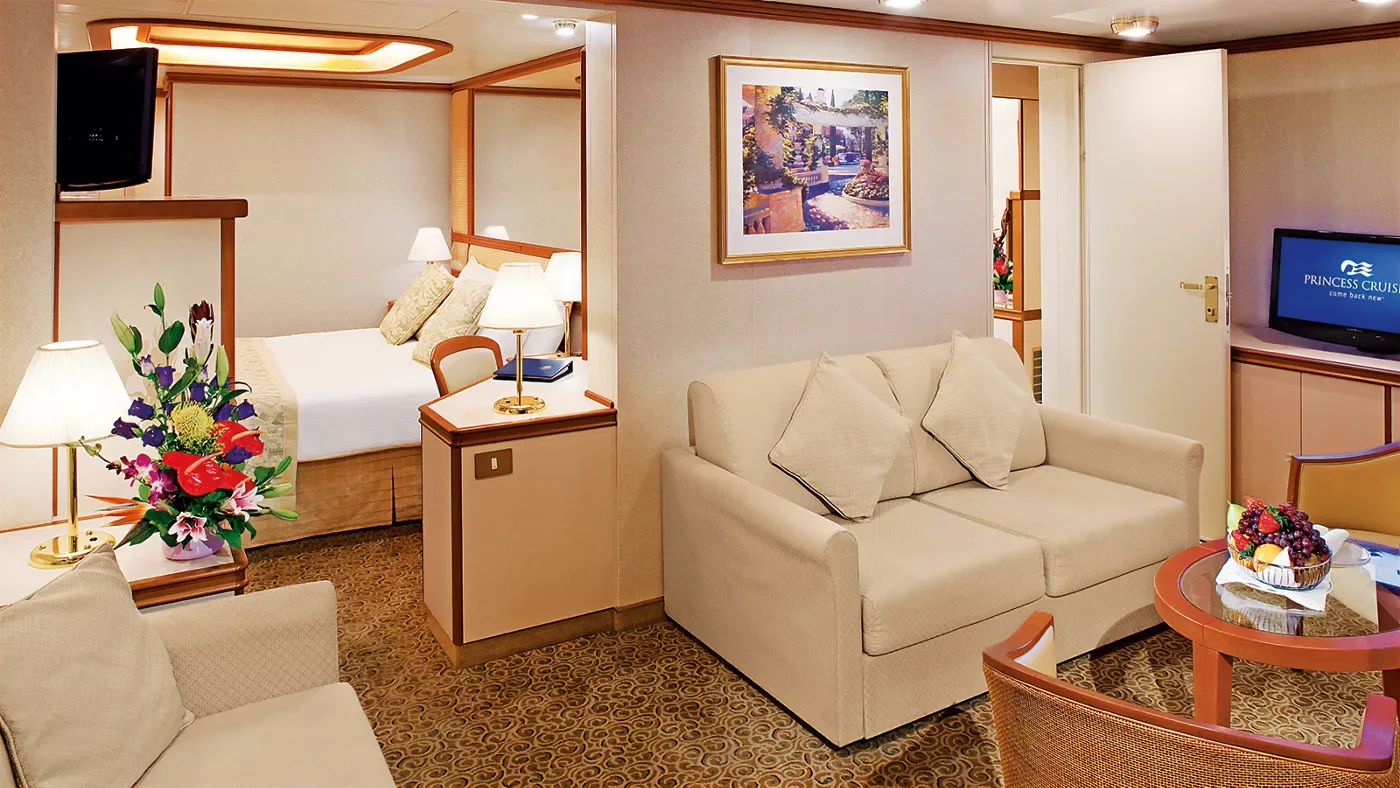
Diamond’s family arrangements are D104 with D100 and D105 with D101, each sold as a linked two-bedroom suite accommodating up to six. Do not apply the fleet’s broader family-suite descriptions that mention eight guests to these particular combinations.
Avoid treating D104 or D105 as a four-person room you can book independently from its companion. The room details require the linked room, and the combined arrangement is what provides the two bedrooms and published 613-square-foot total.
Tell the booking agent everyone’s age and who can comfortably use the sofa beds before comparing this with separate rooms. If you are considering ordinary connecting cabins instead, require an explicitly confirmed internal connection rather than relying on two adjacent room numbers.
Use Princess’s onboard FAQ to plan the children’s needs as well as the room. A bathtub, youth-program eligibility, and a manageable route back for naps may matter more to your family than simply choosing the largest available category.
How this guide was researched
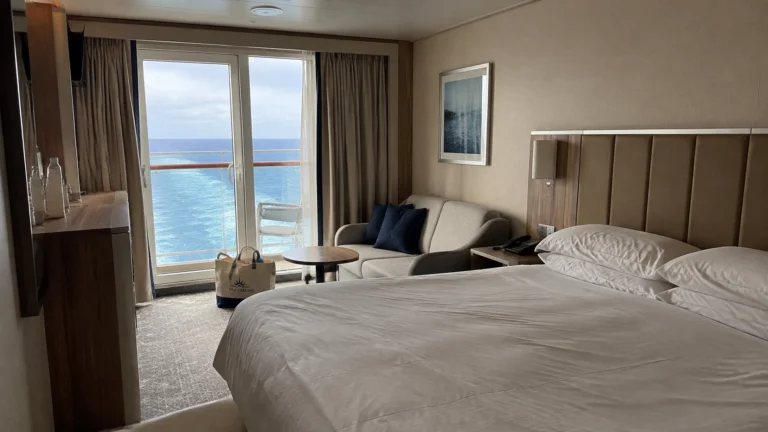
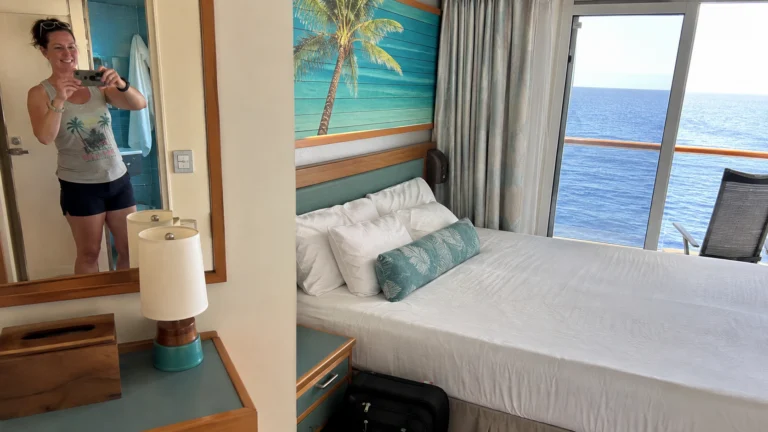
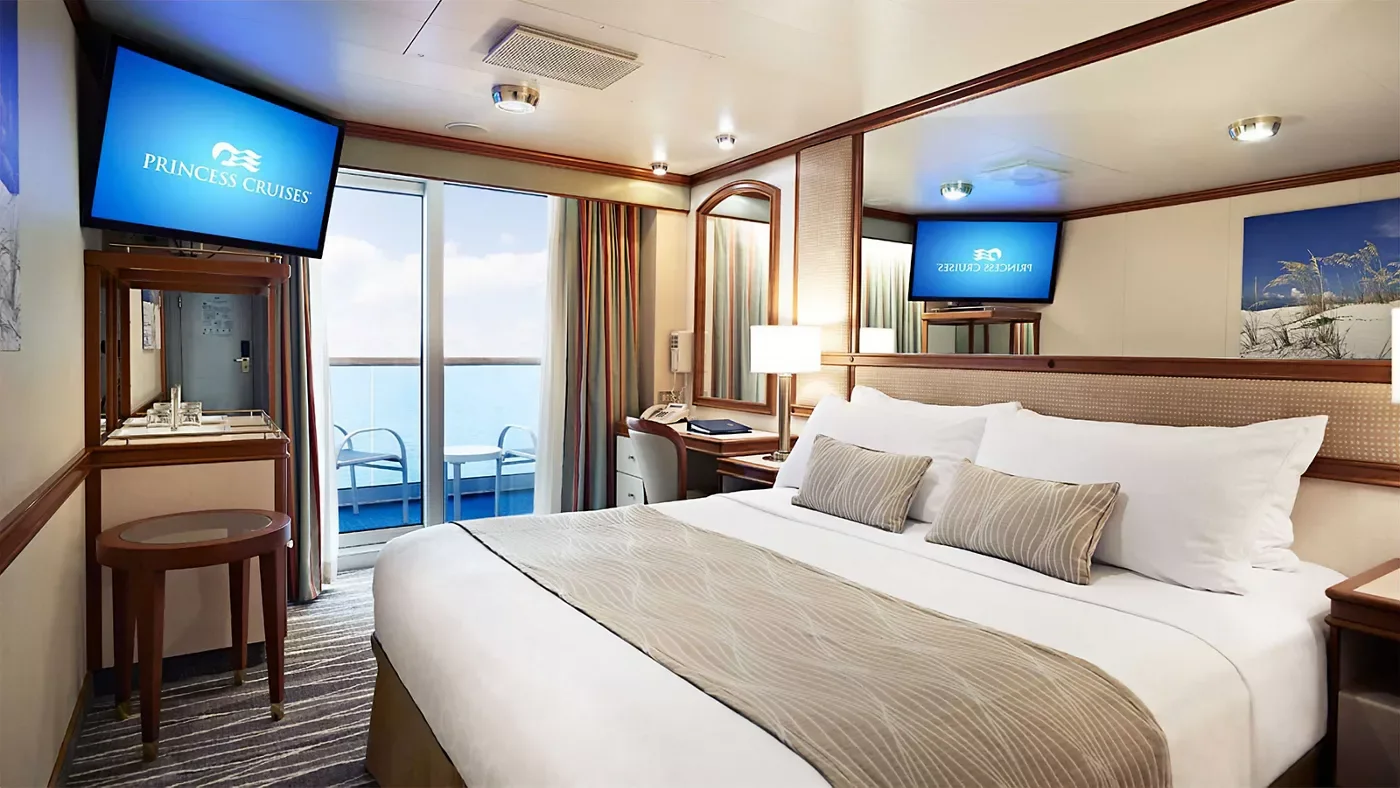
Room comparisons follow Diamond’s cabin details and deck plan, including individual beam obstructions and linked-family beds. Princess dining menus, package terms, youth guidance and Izumi rules supply the relevant costs and access conditions; photographs show representative operator accommodation rather than the numbered candidates.