Carnival Liberty Cabins to Avoid and Better Alternatives
On Carnival Liberty, choose the view, beds, and public-deck relationship before paying for a higher cabin category.
Start with a selected Deck 7 room for residential buffers, then compare the specific compromises of obstructed windows, aft balconies, and high forward suites.
Short version
Choose Deck 7 with cabins above and below when sleep comes first. Treat 2446/2449 as obstructed Ocean Views, 6452/6483 and 8448/8455 as exact corner pairs with different public-deck neighbors, and 9199/9200 as high-forward family suites rather than a motion-focused upgrade.
Forward Picture Window Interiors: not the Scenic room you saw on another ship
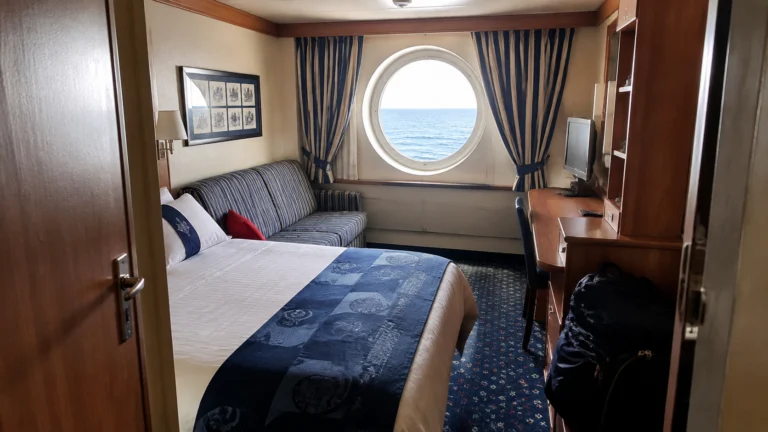
Liberty’s walkway-view interior has a partially obstructed outlook. Choose it for daylight at an acceptable fare, with the public observation walkway and privacy tradeoff understood before booking.
That matters particularly when looking at the forward Deck 9 rooms. A picture window facing a public observation walkway buys a different combination of daylight, view, and privacy from the broad panoramic glass associated with a Scenic category.
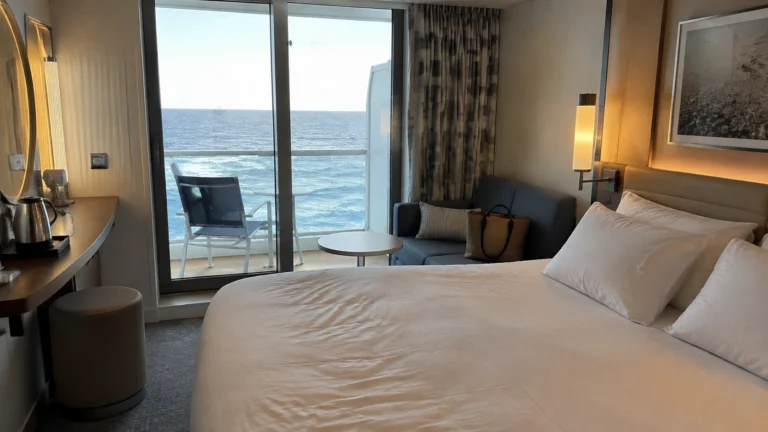
Avoid this setup if you want to leave the curtains open privately while changing or resting. It can still be a sensible daylight bargain for someone who accepts the walkway, but do not pay for it expecting the experience shown in another ship’s room tour.
The simpler replacement is a regular Ocean View with a confirmed outlook. For someone who would keep the picture window covered most of the time, a normal interior may also be the more honest comparison than treating any window as an automatic upgrade.
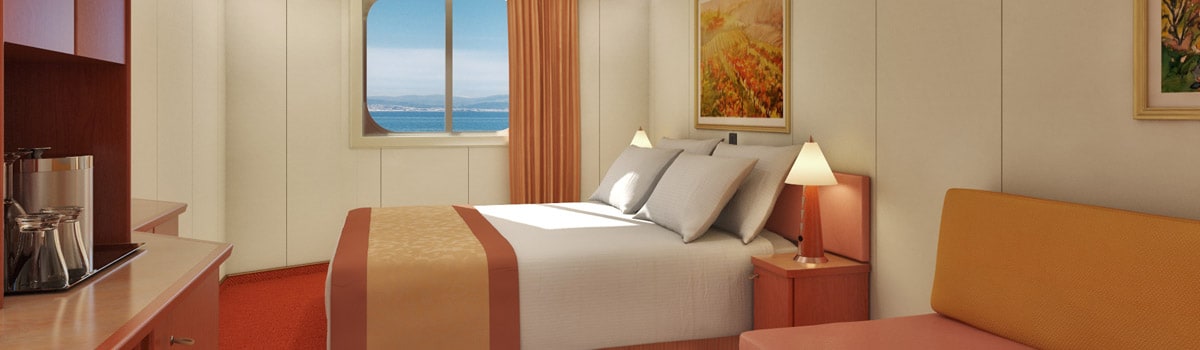
Ocean Views 2446 and 2449: check the actual window before accepting the fare
The official deck plan specifically marks Ocean Views 2446 and 2449 as obstructed. Remove them from a clear-window shortlist unless you have seen the actual outlook and want that tradeoff for the fare.
The restriction can be acceptable when daylight is the goal and the fare is attractive. It is a poor trade when the main reason for paying above an interior is watching the ocean through a clear window.
Ask for a photograph from inside the exact room, then compare another lower Ocean View with the same occupancy and suitable beds. Check its Deck 3 ceiling too, because a better window should not distract you from a less suitable overhead neighbor.
Liberty does not offer Cove Balconies, so that low-balcony suggestion from other Carnival ships does not solve the problem here. Compare Liberty’s actual lower daylight choices by category and room number.
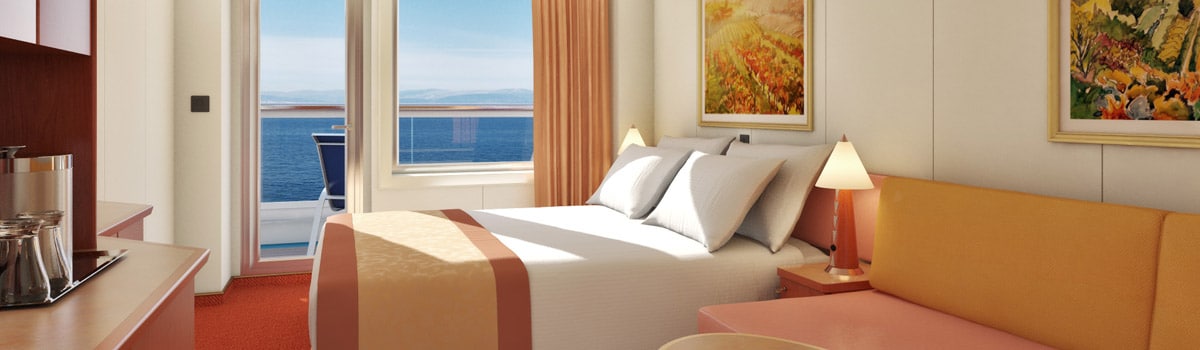
Above Hot & Cool, Piano Man, or Victoria: the nightlife warning
Promenade Deck 5 contains the theater’s upper level forward and Liberty’s casino, Hot & Cool, Piano Man, and Victoria Lounge farther along the evening circuit. A Deck 6 room sits above a particular part of that footprint, so compare the exact area below it before choosing for an early sleeper.
Choose away from direct amplified-entertainment exposure for an early sleeper when a comparable residentially buffered room is available. A room convenient for walking back from a late set may be a poor match for someone who wants to be asleep while it is still running.
Match the room with the venue below, including its stage, service area, and public entrance. For a sleep-focused choice at a comparable fare, select the same broad room type on Deck 7 with accommodation beneath it.
Keep a Deck 6 room when late evenings and a short lounge-to-cabin route are part of the attraction. For an early sleeper, the nearby music is less useful than the residential buffer one deck higher.
Below Tivoli, Emile’s, or Versailles: why Deck 8 is a room-by-room decision
Deck 9 combines forward cabins with Tivoli Pool, Emile’s buffet and food-service areas, and the aft Versailles Pool. A Deck 8 room beneath another cabin should not receive the same warning as one beneath outdoor furniture or working dining space.
Investigate overhead footsteps, chair movement, and preparation when the room sits under an active public section. That is especially relevant to someone who sleeps late or wants a daytime nap while Lido is busy.
A forward Deck 8 room with accommodation above can be a good compromise for a family making repeated pool trips. Check the exact vertical stack rather than assume that every cabin in the forward section has identical surroundings.
For someone who does not particularly need one-flight access to breakfast, prefer a cabin-buffered Deck 7 alternative. A higher deck earns a premium only when its convenience is useful enough to justify the actual ceiling.
A lower room under the galley is not automatically the quiet bargain
Deck 2 deserves a check against the Deck 3 dining and galley layout. Passenger dining, preparation areas, and service circulation create different overhead conditions, so a broad restaurant label is not enough to settle the room choice.
Avoid a working galley ceiling for someone sensitive to overhead impacts when another lower Ocean View is available. The low position can still be useful for motion, but it does not make kitchen activity disappear.
Compare Deck 1 or another lower room outside that footprint, keeping the window and bed needs unchanged. A residential ceiling addresses this particular concern more directly than moving to a higher category simply because it sounds more comfortable.
Far-forward lower rooms still need their own operational-noise and motion checks, while far-aft rooms add longer routes to forward venues. Choose the complete location rather than let one desirable feature cancel every other consideration.
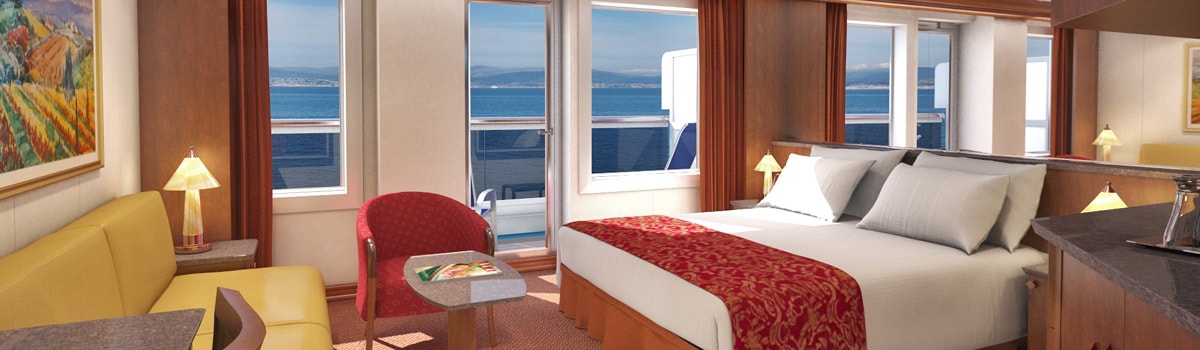
Premium Vista corners: the balcony is lovely, but compare the neighboring decks
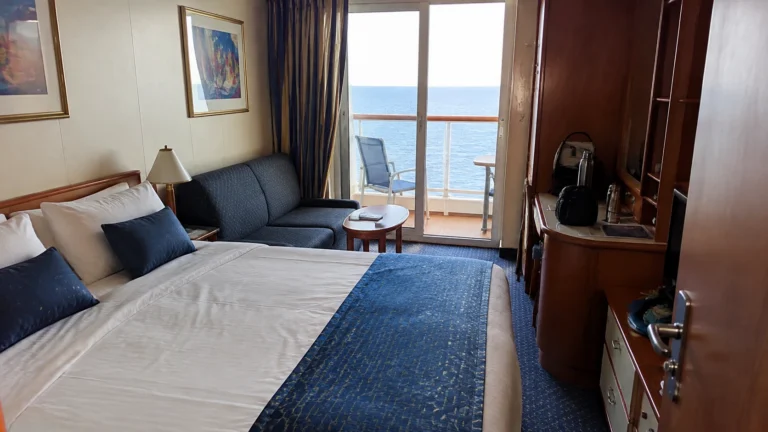
Liberty’s Premium Vista corners include 6452 and 6483, 7440 and 7445, and 8448 and 8455 across Decks 6, 7, and 8. The wraparound outdoor space is the attraction, while the public-deck relationship changes with the chosen pair.
For the Deck 6 pair, inspect the aft Promenade footprint below; for the Deck 8 pair, inspect aft Lido above. Compare the Deck 7 pair when you want the corner balcony and residential buffers before considering a different deck’s fare or convenience.
That does not guarantee a quiet room, and the deck map cannot predict a stern vibration outcome. Also compare the aft walk, sun exposure, and actual overhang before paying more for a view you intend to use every day.
Compare a standard side balcony near the elevator bank you will use most when long walks or limited balcony time make an aft corner less useful. The best cabins guide separates outdoor-space upgrades from room layouts that improve family sleeping or bathroom access.
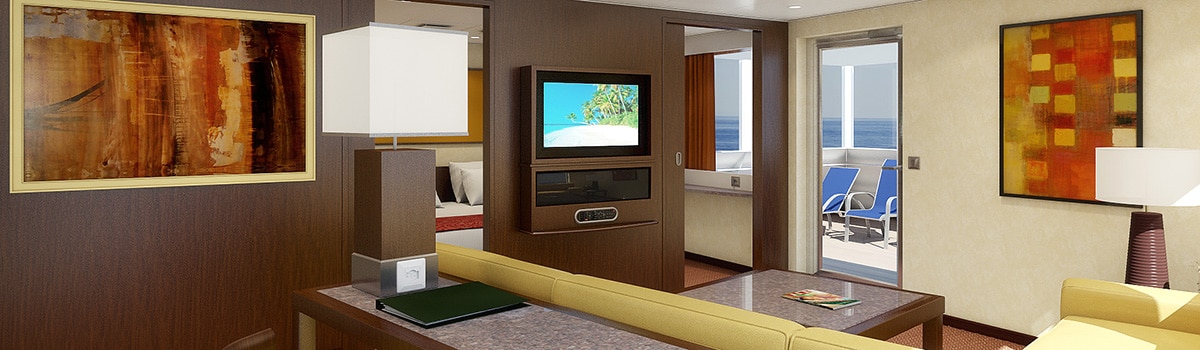
High-forward rooms need a motion comparison
Forward Lido accommodation can make pool and casual-food trips very convenient, but it remains higher and farther toward the bow than a lower midship room. Do not choose it for a motion-sensitive traveler solely to shorten the breakfast trip.
Liberty’s Captain’s Suites are 9199 and 9200, not the numbers used for that category on several sister ships. They offer a materially different family layout, but their high-forward position is still part of the booking.
Compare a more central Ocean Suite when extra indoor room matters but the forward position does not suit the family. For a couple who mainly wants daylight, a lower midship Ocean View may solve the problem without buying an elaborate suite at all.
The small upper cabin sections also need a check against the spa, fitness, or outdoor area immediately above. Proximity to a relaxation venue does not establish a silent ceiling, and being nearby does not automatically grant a paid spa benefit.
Beds and accessibility: the room needs to work after the extras are opened
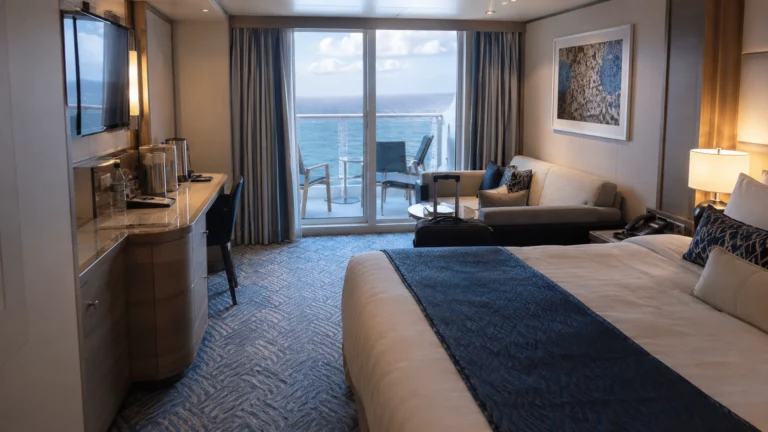
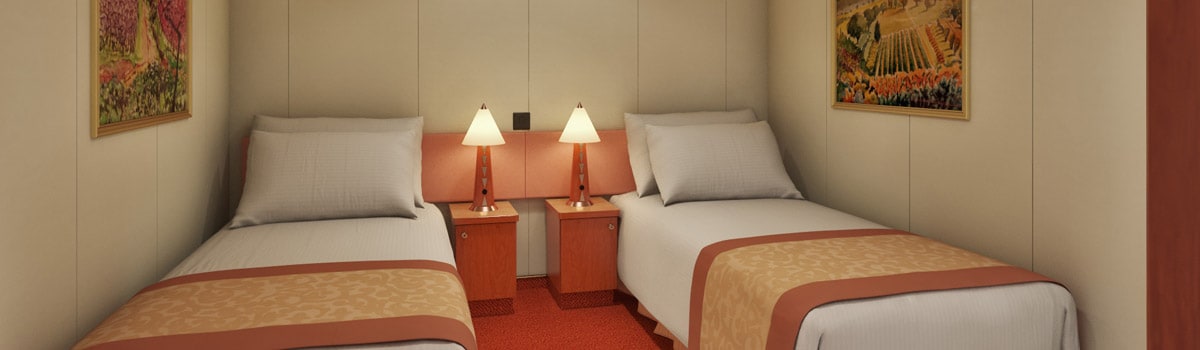
Confirm the exact twin, sofa, and Pullman symbols before choosing for three or four travelers. A daytime photo with the extra beds tucked away does not show how much clear floor space remains at night or who must climb into an upper berth.
An Upper/Lower room is a different arrangement from the usual convertible twin pair, so do not book it for a couple expecting a standard shared bed without checking. If separate beds are essential, get that configuration confirmed for the actual room rather than assume a category photograph settles it.
For families needing separation, price two confirmed connecting rooms as well as one larger cabin. The internal-door symbol matters; being next door is not the same as being connected, and an unnecessary connecting door is not a feature to seek for a sound-sensitive couple.
For mobility needs, start with the accessible room requirements and confirm the exact bathroom, thresholds, transfer space, and equipment storage. An ordinary suite is a different product even when its floor area is larger.
Choose the room around your routine
Compare ordinary Deck 7 balconies 7340 and 7344 when you want cabin floors above and below, or a forward Deck 8 room when Lido convenience matters more. Choose the exact beds and outlook first, then keep the saving when a category’s compromise barely affects your routine.
Decline a guarantee if one of those details is nonnegotiable. The guarantee terms govern the assignment, so the saving needs to compensate for the eligible rooms you could receive, not just the one you hope for.
Use the deck guide to trace breakfast and evening routes, then the practical tips to plan the services and venues you will repeat. Choose the actual room whose beds, view, and route fit, rather than a category label that sounds better.
How this guide was researched
Room comparisons use Carnival’s accommodation descriptions, accessibility guidance, and the numbered deck plan. The photos are representative category images; advice about public-deck neighbors describes the layout rather than measured sound levels.