How this site works
Editorial Standards and Corrections Policy
Effective date: September 3, 2026
Last reviewed: September 3, 2026
Owner and editor: Ellie Simons, founder of CruiseShipInsights.com
This page explains how CruiseShipInsights researches ships and cabins, what evidence a claim needs before it gets published, how corrections work, and where money enters the picture. It’s written out in this much detail because a cabin warning is a real decision for a reader, and you should be able to see the reasoning behind it.
Editorial independence
Every editorial decision on this site is made by Ellie Simons. Affiliate links, advertising, complimentary access, and any other commercial relationship do not buy coverage, placement, or a favorable conclusion. If a material relationship applies to a specific article, it’s disclosed on that article. The general position is on the Affiliate Disclosure and Cruise Travel Disclaimer page.
Firsthand experience versus research
This distinction runs through everything on the site. Content falls into one of these categories, and the writing should make clear which one applies:
- Firsthand. Ellie personally sailed the ship, stayed in the cabin, or used the venue described.
- Independently researched. Compiled from official sources and passenger accounts, without any claim of personal experience.
- Editorial judgment. An opinion drawn from the research. “I’d avoid this cabin” is a recommendation, not a report of something that happened to me.
- Reviewed and updated. An existing guide rechecked against current sources and revised where the ship has changed.
Articles never imply a sailing, a cabin stay, or an onboard experience that did not happen. Nobody has slept in every cabin on every ship, and a site that writes as though it has is not being straight with you.
Where facts come from
Two kinds of information go into a cabin guide, and they come from different places.
Objective characteristics come from the cruise line and other official sources: current deck plans, cabin categories, published dimensions, obstructed-view designations, accessible cabin layouts, connecting-room configurations, deck and location, and refurbishment announcements. If the cruise line’s own deck plan says a cabin is on Deck 8 forward and has a lifeboat in front of the window, that’s settled.
Experience comes from passengers. Cruise forums, Cruise Critic threads, Reddit discussions, cruise line and third-party reviews, publicly posted firsthand accounts, and cabin tour videos where they show something a floor plan can’t. These sources are used to understand what it’s like to be in a room, not to establish technical facts about the ship.
Keeping those two streams separate matters. An official source is the authority on what a cabin is. Passengers are the authority on what it’s like.
The evidence standard for a cabin warning
For an experiential warning, meaning a claim that a specific cabin or block of cabins is noisy, shakes, smells, gets foot traffic, or is otherwise unpleasant, the standard is:
- At least two genuinely independent passenger reports describing the same problem, and
- Corroboration against the ship’s current deck plan or configuration that explains why the problem would occur there.
An example of that working: passengers repeatedly report bass from a nightclub, and the deck plan shows the cabins in question sit directly above that venue. The physical layout explains the reports, and the reports confirm the layout matters. That gets published.
An example of it not working: one review says a cabin was awful, nobody else mentions it, and there’s nothing on the deck plan nearby that would cause a problem. That’s a lead worth watching, not a fact worth publishing. It might have been the neighbors.
Things that don’t need two complaints
Some characteristics are established by the cruise line, not by passenger experience, and a single authoritative source settles them:
- An official obstructed-view or partially obstructed designation.
- Published cabin dimensions and balcony size.
- Official accessible cabin layouts and features.
- Deck and physical location on the ship.
- Cabin category and what it includes.
- Connecting-room configuration.
The important thing is to keep the characteristic separate from the verdict. “This cabin has a partially obstructed view” is a fact from the cruise line. “That obstruction ruins the cabin” is my opinion, and it depends entirely on whether you booked the room for the view or for somewhere to sleep. The guides should always make it obvious which half you’re reading.
What counts as an independent report
Two reports means two people who each sailed and each noticed. It does not mean the same complaint appearing on ten websites.
A lot of cabin advice online traces back to a single original post that got quoted, aggregated, rewritten and syndicated until it looks like a consensus. It isn’t one. When I trace a claim back to one source, it counts as one source. Copied comments, scraped roundups and articles citing each other in a circle add nothing.
Reports from the same sailing are also treated carefully. Two people on the same cruise who both heard the same one-off event have told me about that event, not about the cabin.
When passenger reports disagree
They often do, and that’s useful information rather than a problem to hide. People differ in how sensitive they are to noise and motion, when they sleep, how much privacy they want, and how much they care about a view. Ship operations vary too: a venue’s programming changes, a piece of machinery gets serviced, a sailing is unusually full.
So a recurring drawback doesn’t make a cabin terrible for everyone. Where reports conflict, the guides try to answer four questions instead of issuing a verdict:
- Who is likely to be bothered by this, and who probably won’t notice?
- How serious does the issue appear to be?
- Do the reports agree, and if not, what might explain the difference?
- Is there a better cabin nearby at a similar price?
Ships change, and old reports expire
This is the single biggest weakness in most cabin advice on the internet. A cruise ship is not a fixed object. Over its life it can go through:
- Refurbishment and dry dock work.
- Venues being relocated, rebranded, or replaced entirely.
- New cabins added, often on upper decks.
- Cabin renumbering.
- Category changes and reclassification.
- Transfer to a different operator, sometimes with a new name.
Before a claim gets published, the configuration behind it is checked against the ship as it exists now. A complaint about noise from a disco that was converted into a conference room three years ago is a historical curiosity, not a warning. Older reports are used cautiously, and where a meaningful physical change has happened, the guide should say so rather than quietly carrying the old conclusion forward.
Reader submissions
Firsthand cabin reports from readers are welcome and genuinely valuable. They’re also treated as leads rather than as published fact. A submission gets checked against the current deck plan and against other independent accounts before it changes what a guide says, and it’s held to the same two-report standard as anything else.
If you send a report, please include the ship, the cabin number, the sailing date, what you experienced, when it happened, and whether it repeated. The contact page has the full list.
Corrections
Corrections get priority over everything else. If something here is wrong, tell me through the contact page. Useful things to report include:
- A wrong cabin number or deck.
- A cabin listed in the wrong category.
- A venue that has moved, closed, or changed.
- A deck plan that no longer matches the ship.
- Refurbishment work that isn’t reflected here yet.
- Any other factual error about a ship.
- Broken links and pages that display badly.
How the fix is handled depends on what changed. A typo, a formatting problem or a clarity edit is simply fixed. A correction that materially changes what a reader would understand or decide gets a visible correction or update note on the article explaining what was wrong and when it was fixed. Cabin numbers, deck locations, categories and warnings all fall on the material side of that line.
Update dates mean something
A displayed update date on this site reflects real editorial work. It doesn’t get bumped to make an article look recently maintained. Things that earn a new date:
- A newer deck plan was reviewed against the article.
- Cabin numbers or categories changed.
- A refurbishment was incorporated.
- A material factual correction was made.
- Substantial new passenger evidence changed a conclusion.
- The ship moved to a different operator or configuration.
AI assistance
AI tools are part of the workflow here, and pretending otherwise would be silly. They’re used for organizing research, drafting outlines, cleaning up data, grammar and consistency checks, spotting duplication, and general production work.
What they are not is a source. An AI tool does not know which cabin sits above a nightclub on a specific ship, and anything it produces that looks like a ship fact is checked against a deck plan or an official source before it appears on the site. Editorial decisions, evidence judgments and everything published under my name are mine. You won’t find a “100% human written” badge here, because it wouldn’t be accurate.
Originality and attribution
- Writing here is original. Guides are not rewrites of someone else’s article.
- Quotations use quotation marks and attribution. Summaries are written independently.
- Deck plans, ship images and other third-party material remain the property of their owners and are used only where permitted.
- Images that carry information get useful alt text.
- Titles, descriptions and structured data describe what’s actually on the page.
Complimentary travel and products
If CruiseShipInsights ever accepts a complimentary sailing, cabin upgrade, tour, product or other material benefit connected to coverage, that relationship will be disclosed clearly on the affected article. Accepting something does not change a conclusion, and coverage is never promised in advance.
Related pages
This policy is reviewed whenever the way the site works changes materially, and otherwise periodically.
Images and AI-generated illustrations
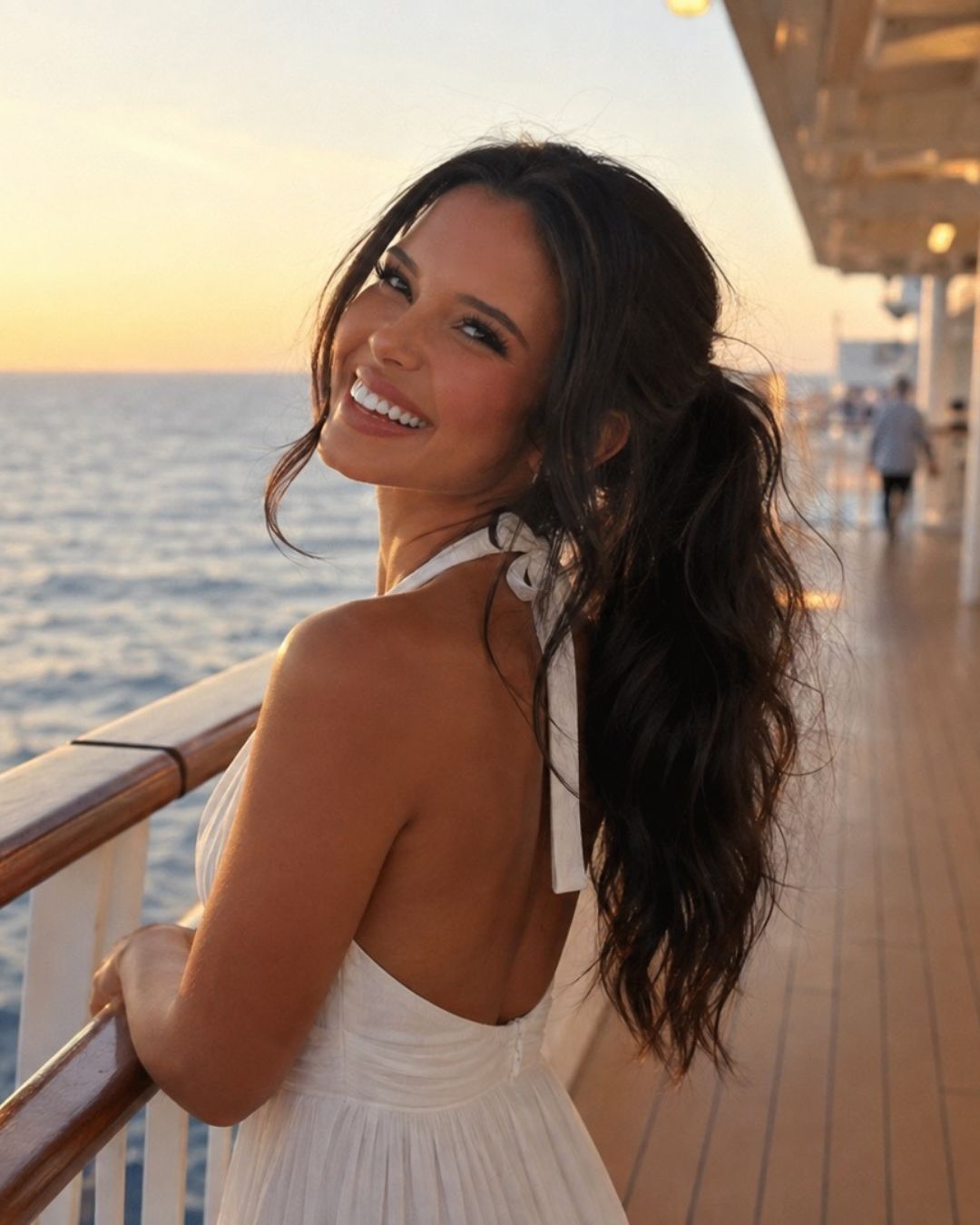
Photographs and illustrations are held to the same transparency rule as the writing. A real photograph is not described as firsthand if it was not taken by Ellie, and an AI-generated or otherwise synthetic image is never presented as documentary proof of what a specific cabin, view, fixture or ship feature actually looks like.
When a generated image is used for visual context, it should be clearly identified as an illustration rather than a documentary photograph. Any cabin detail that matters to a booking decision is checked against current deck plans, official specifications or verifiable real-world imagery rather than inferred from a generated picture.
Spotted a mistake?
Corrections get priority over everything else on this site.